

On 11 June, a roundtable discussion hosted by Medicus Mundi Switzerland raised the following question: Is a new narrative for international cooperation in health needed?
But why was this question raised in the first place? Several factors seem to explain it, including growing concerns about the transparency and effectiveness of NGOs’ work, declining interest in the values of global solidarity, and, above all, the massive cuts in Swiss and international funding for development cooperation projects. This situation is prompting actors in the sector to take a step back and reflect on their approach.
In principle, this is not necessarily a bad thing. However, we are now facing a tension: in a climate increasingly shaped by narratives of quick and magical solutions, how can we demonstrate our usefulness withoutpromising endless results? How can we explain – and accept – that not everything works perfectly? Yet this is something we are bound to face, because we operate in complex environments whose many variables and future developments are beyond our control. International cooperation in health has been around for many years and, although much remains to be done, these efforts have also produced tangible results. Perhaps, then, rather than relying on promises to convince people of our usefulness, it would be better to reaffirm who we are and emphasise what we have been doing concretely for many years.
The next question is: how can we show that the work of health cooperation NGOs remains as relevant as ever?
Health is fundamentally individual. This distinguishes it from other major areas of development cooperation, such as education, infrastructure, the environment or peace, which may, at first glance, appear to have a more collective dimension. Yet one point became clear during our discussion: health is a prerequisite for progress in all these areas, as it determines people’s ability to learn, work and participate in social life. Strong health systems therefore contribute to human dignity while also strengthening societies’ capacity to develop their own responses to the challenges they face today and will face in the future. Health is therefore not only an end in itself; it is also a driver of development.
Presenting health cooperation solely through the lens of individual charity limits our understanding of its role. Seeing it instead as a pillar of economic and social development, interconnected with every aspect of society, highlights its fundamental importance.
Ultimately, as stated in the Swiss Constitution: “The strength of a community is measured by the well-being of its weakest members.”
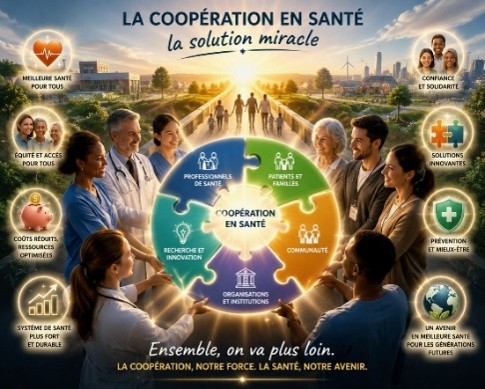
AI-generated image. It humorously captures the tension between the complex realities we face on the ground and the simple messages we are often expected to deliver to demonstrate the value of our work as a health NGO.
Recent Comments